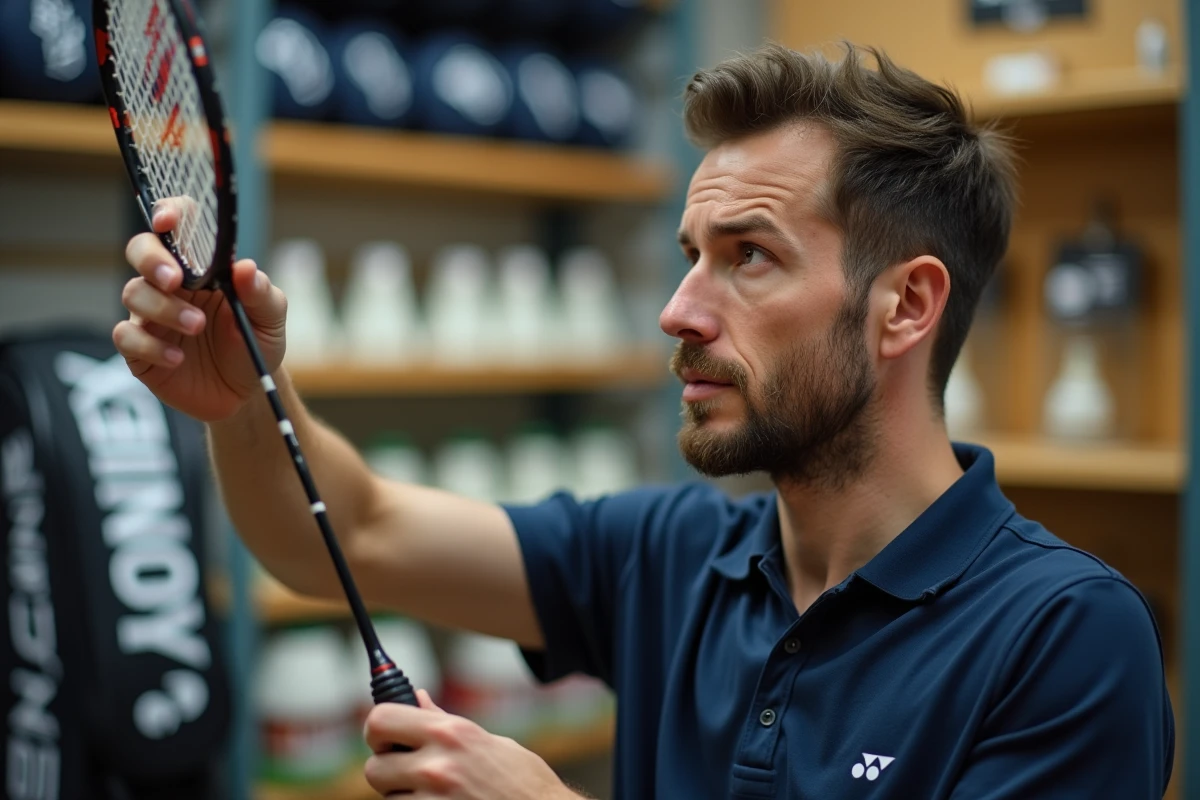
The secondary market for Yonex rackets is filled with copies whose manufacturing quality improves every year. Distinguishing a counterfeit from an authentic model requires cross-referencing several physical indicators, rather than relying on a single visual criterion. Here, we detail the technical checkpoints we use to authenticate a Yonex racket before any transaction.
Yonex Hologram: Micro-details that Counterfeits Do Not Replicate
The hologram attached to the handle is the first element to inspect, but not in the way most guides describe. On an authentic racket, the hologram is highly resistant to peeling: when attempting to peel it off with a fingernail, it fragments into small pieces instead of coming off in one piece.
On a counterfeit, the sticker peels off cleanly, almost without resistance. This mechanical behavior is due to the multilayer structure of the official hologram, designed specifically to prevent the transfer from one frame to another.
We recommend testing the peeling on an edge of the hologram before even looking at the visual aspect. A hologram that lifts in one piece indicates, in almost all cases, a counterfeit. To reliably check the origin of a Yonex, this tactile test effectively complements the visual examination of the iridescent reflection.
Yonex Logo and Typography on the Frame: Spotting Engraving Discrepancies
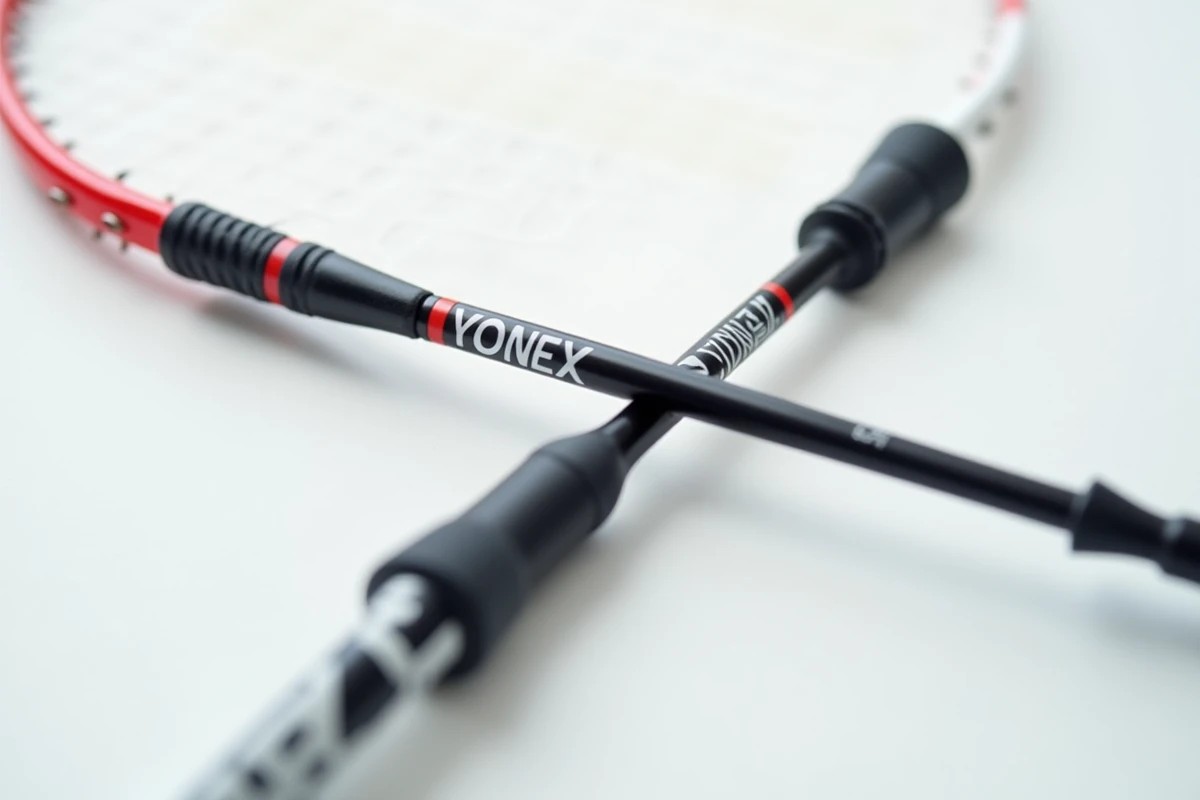
The “yy” logo of Yonex, present on the cone and handle, adheres to strict proportions. On an authentic frame, the two letters are perfectly symmetrical, with sharp serifs and consistent spacing.
Counterfeits often reveal irregularities in this specific area:
- The serifs of the “y” are slightly thicker or thinner on one side than the other, creating visible asymmetry under magnification.
- The ink or paint of the logo slightly overflows onto the frame, indicating a less precise stencil.
- The font used for the model name (Astrox, Nanoflare, Arcsaber) has a letter spacing different from that of the official catalog.
Comparing the typography with a high-resolution photo of the same model on your regional Yonex website remains the most direct method. Any variation in font or spacing on the model name is a strong warning signal.
Production Number on the Butt Cap: Structure and Consistency
Every authentic Yonex racket bears a production code engraved or printed on the butt cap at the bottom of the handle. This code follows a precise format that provides information about the location and period of manufacture.
On counterfeits, we observe two recurring scenarios. The first: the code is absent or replaced by a sequence of random characters without identifiable logic. The second, more deceptive: a plausible production code but inconsistent with the model. For example, a number associated with an Arcsaber series printed on a frame sold as an Astrox.
Color and Finish of the Butt Cap
The butt cap of an authentic Yonex racket uses plastic whose shade exactly matches the official color of the model. Counterfeits frequently exhibit a butt cap of a slightly different hue, often duller or shinier than the original.
This detail goes unnoticed if you have never handled the authentic model. We recommend checking reference photos on the official product pages or comparing physically in a specialized store.

Racket Balance and Weight: The Test That Sellers Overlook
The weight and balance of a Yonex racket are factory calibrated with very low tolerances. The specifications are listed in the technical sheet of each model on the official site. A notable deviation in total weight or balance point indicates either a counterfeit or a lower-quality product sold under a false label.
To perform this check, a kitchen scale accurate to the gram is sufficient. Weigh the racket without strings or overgrip. Compare the result to the range indicated by Yonex for the model and grip size concerned.
The balance can be checked by resting the handle of the racket on a finger and finding the pivot point. A shift in the balance point of more than one centimeter from the official specification warrants attention. Counterfeits use composite materials of different densities, which systematically shifts the center of gravity.
Purchase Channels and Precautions Before the Transaction
Yonex counterfeits mainly circulate on general marketplaces and classified ad sites. Authorized resellers by Yonex in each country are listed on the brand’s official website, and this channel remains the only one that guarantees authenticity without further verification.
When purchasing second-hand or from an unlisted seller, we recommend systematically cross-checking the controls described above:
- Hologram peeling test before finalizing the sale.
- Verification of the production code on the butt cap and comparison with the advertised model.
- Weighing the racket and comparing it with the official specifications.
- Examination of the logo typography and model name under magnification or macro photo.
A seller who refuses to let the buyer handle the racket or inspect the butt cap before payment represents a high risk. The combination of these checks allows for the elimination of the vast majority of counterfeits, including the most carefully made copies that deceive at first glance.