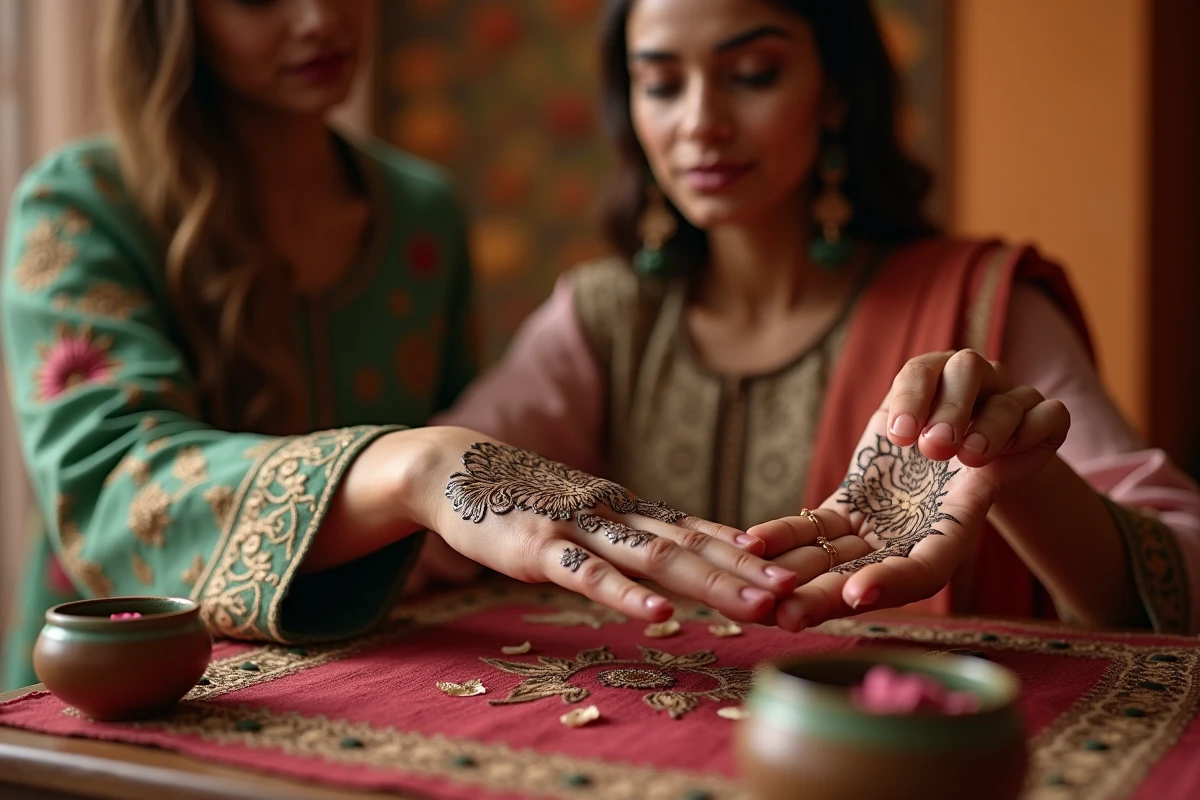
Henna applied to the hands does not produce exactly the same result on the right and left. The difference is due to physiological factors that are rarely taken into account: blood circulation, skin thickness, and habitual gestures. Before choosing a pattern or application technique, understanding these mechanisms allows for adjustments in the process to achieve a uniform result on both hands.
Blood circulation and henna oxidation: why the color differs between the right and left hand
The dominant hand receives a slightly higher blood flow than the other. This more active vascularization increases the local temperature of the skin, which accelerates the oxidation of the tannins contained in henna (lawsone). The result: the dominant hand often takes on a darker hue with the same application time.
For a right-handed person, the right hand will generally display a more intense color than the left after the same duration of application. The opposite is observed in left-handed individuals. This phenomenon, documented by dermatologists specializing in natural cosmetics, explains why two hands tattooed simultaneously do not age in the same way.
The most straightforward tip is to extend the application time on the non-dominant hand by a few dozen minutes. Some practitioners also apply an occlusive balm (like shea butter) on the dominant hand just before application, to slightly slow down absorption and balance the final result. To delve deeper into preparation techniques, find tips for henna on the hands detailing each step of the process.
Black henna and PPD: the specific risk on the dominant hand
“Black henna” is not henna. It contains para-phenylenediamine (PPD), a synthetic molecule banned in temporary tattoo products for skin in Europe since the update of regulation (EC) No. 1223/2009 by regulation (EU) 2023/1490.
The dominant hand accumulates more invisible micro-injuries on a daily basis: keyboard use, cooking, DIY. These micro-cuts facilitate the penetration of PPD into the epidermis and increase the risk of contact eczema or chemical burns. The European Chemicals Agency (ECHA) has published a summary of notifications covering the period 2022-2024, reporting an increase in cases of PPD allergy related to temporary tattoos, particularly after tattoos done on vacation.
The trap is easy to identify:
- Natural henna (Lawsonia inermis) gives a green to brown-green paste, never black upon application. The final color varies from orange to brown-red depending on the application time and the area of the body.
- A product that promises a deep black in less than an hour almost certainly contains PPD or an unauthorized chemical dye.
- The mention “enriched natural henna” without a complete INCI list should raise a red flag: demand the composition before any application.
Preparing the skin of both hands before henna application
The quality of the result depends as much on the preparation as on the henna itself. The palm and the back of the hand do not have the same skin thickness, and the skin on each hand reacts differently depending on its hydration state.
Exfoliation and targeted cleaning
A gentle scrub done the day before application removes dead skin cells and evens out the surface of the skin. Focusing on the non-dominant hand, which is often a bit drier, helps reduce the color uptake difference between the two hands.
On the day of application, clean the hands without greasy soap or moisturizing cream. Oily substances create a barrier that prevents the tannins from penetrating the epidermis. A simple rinse with warm water is sufficient.
Choice of area and skin thickness
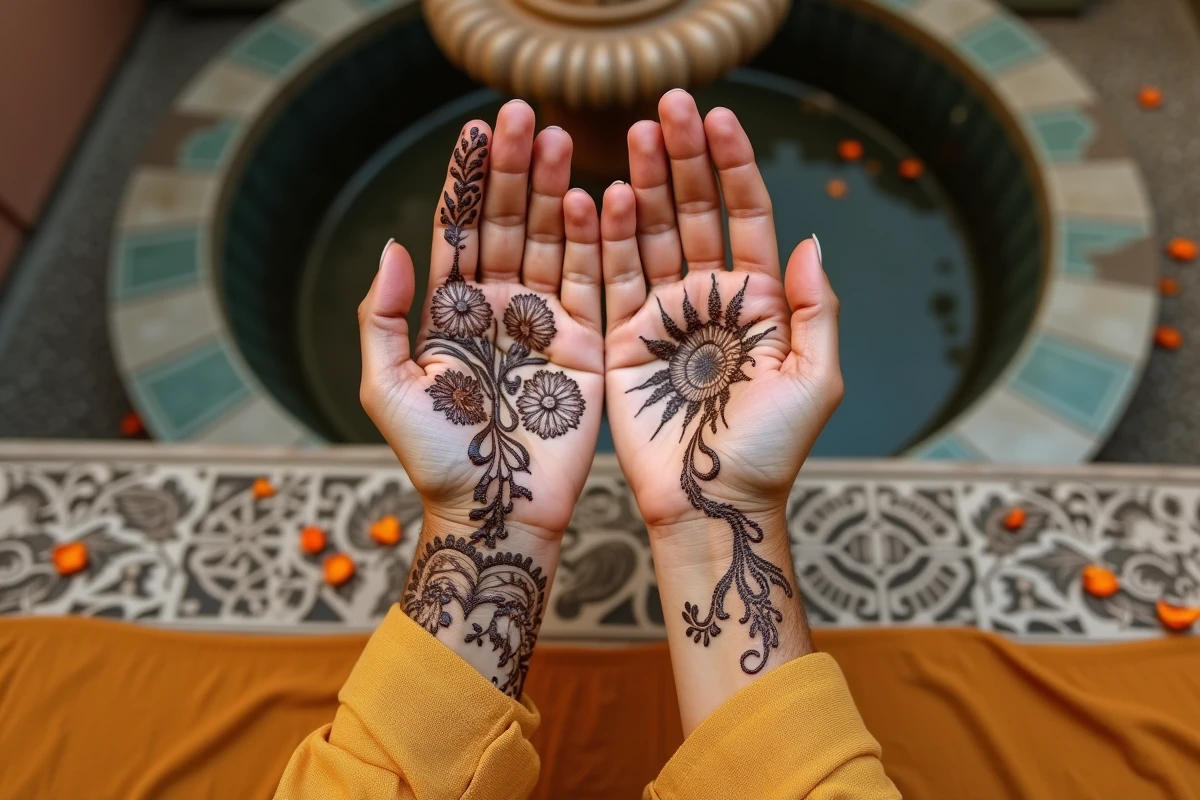
The palm takes on a more intense color than the back of the hand due to a thicker stratum corneum that retains more pigment. Patterns placed on the fingers and palm also last longer.
In contrast, the back of the hand gives a more subtle result, which fades more quickly. If you want a tattoo visible for more than ten days, prioritize the palm and the inner sides of the fingers.
Application time and henna fixation on the hands
Application time is the most underestimated variable. Removing the paste too early produces a pale orange, while leaving it on too long on thin skin can irritate without improving the color.
- On the palm (thick stratum corneum), a prolonged application time yields the best results. The color continues to darken during the 48 hours following the removal of the paste.
- On the back of the hand, slightly reduce the application time compared to the palm, as the skin there is more reactive and thinner.
- To balance the two hands, apply henna first on the non-dominant hand, then follow with the dominant hand. The delay of a few minutes compensates for the difference in vascularization.
After removing the dried paste, avoid any contact with water for at least twelve hours. The final oxidation occurs in the open air, and premature washing stops the process before the shade reaches its maximum depth.
Patterns suited to the hand and morphology
The choice of pattern depends on the available surface area and the use of each hand. On the dominant hand, patterns located on the edge or between the fingers fade more quickly due to repeated friction. It is better to place centered designs on the palm or back.
Fine and detailed patterns (like Indian mehndi with tight fills) hold better on the palm, where the skin retains pigment more evenly. On the back of the hand, wide swirls and spaced geometric patterns age more elegantly, as fine lines on thin skin tend to blur as they fade.
Wider hands can support symmetrical compositions covering the entire surface. On thinner hands, an asymmetrical pattern starting from the wrist towards one or two fingers creates a more visually balanced effect than full coverage.
The difference in result between the right and left hand is not a flaw. It is a physiological fact that, once understood, becomes a working parameter. Adjusting the application time, adapting the preparation of each hand, and choosing patterns based on the application area is enough to achieve a controlled result on both hands.